

The professional learning and development model
Professional learning and development cycle
The evidence and verification requirement in the registration renewal process is based on the following model
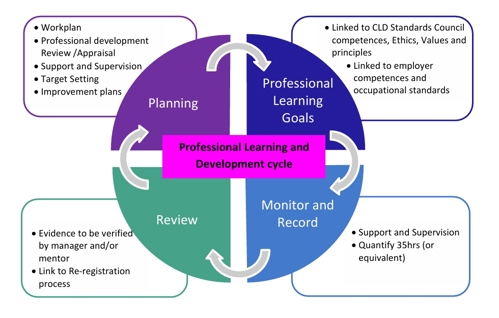
This model is based on an action review cycle in line with what could be called plan-do-review model as advocated by commentators such as Donald Schon (1987), who was seminal to a range of professional development models and in particular those of teaching, social work, nursing and CLD in Scotland.
This approach is used extensively in qualifying training of CLD practitioners and our intention is that this discipline to professional learning and development is extended beyond initial training. The assumption that this approach to the development of professional knowledge and competence is embedded in a practitioner’s practice and to make it career-long by associating the process with registration renewal.
The model recognises the contextual nature of a CLD practitioner’s practice (Eraut, 19944) and the need for the participant to recognise, explore and address through critical reflection, the relationships between their professional constituency, professional standards and organisational and employment requirements (Kennedy 2008).
The model is based on the notion of an autonomous self-directing practitioner that through critical reflection on practice identifies their professional learning and development needs and brings these forward for verification in dialogue with a significant other, that being, someone with a relevant understanding and working knowledge of CLD with respect to the Professional Standards and this person can be their manager and/or a mentor.
The 4 quadrants of the model are meant to be in line with the workplace planning and review system that CLD practitioners may operate within their work setting and therefore be complementary and helpful with respect to enabling a focus on professional learning and development as well as the occupational requirements to be met.
Although the Registration Renewal submission is a requirement every three years it is assumed that work planning, support and supervision and review is a workplace process and is on going.
Planning
At the planning stage the practitioner should identify the needs and challenges coming out of key processes and documents. These include:
- work plan
- professional development review or appraisal
- support and supervision
- target setting
- improvement plans
- inspection reports
- community planning and Local Outcomes Improvement Plan (LOIP)
Professional learning goals
Drawing on the needs and challenges identified in the planning stage and other sources, this dimension of the model encourages the setting of professional learning goals with respect to the practitioners learning needs and concerns.
Some questions that might be useful in setting professional learning goals might be:
- What is the focus of your professional learning and development?
- What will your professional learning and development look like? (e.g. enquiry, further study, collaborative activity, project and development work)
- How do these learning goals relate to CLD Standards Council Professional Standards (i.e. competences, ethics, values and principles)?
- Will they be SMART (Specific, Measurable, Achievable, Relevant and Time Limited)
- In what way will setting your learning goals relate to organisational needs and any employer competences?
Professional learning and development goals are linked to
- CLD Standards Council competences, ethics, values and principles
- employer competences and occupational standards
Monitor and record
Keeping a record of professional learning and development activity allows the practitioner to review and monitor achievement of goals and carry out planning for future learning.
The practitioner also needs to keep a record for the purposes of Registration as they might be selected to provide evidence of their professional learning.
The practitioner should:
- decide how they will monitor and record their professional learning and development. Will it be an integral part of a workplace monitoring and recording system or a separate but related system?
- link their support and supervision with their professional learning goals
- identify someone to discuss, monitor and review progress with , (usually manger and/or mentor).
This person will usually also carry out the 3 year Professional learning review and verification.
The practitioner and mentor should agree:
- their roles and responsibilities
- the mechanism and timings of the process of critical reflection on the progress of the practitioners professional learning and development
See notes on appropriate verifier. A suggested mentor agreement form is available.
Review
This part of the process requires a professional dialogue and verification between the practitioner and their manager /mentor with respect to progress with their professional learning and development and its impact on their practice and how this is fed forward into the next professional learning and development planning cycle.
Questions that might be helpful in the review stage
- What impact/change, if any, do you anticipate for:
- your thinking and understanding
- your professional actions
- your interactions with learners and the community?
- How will you know the impact your professional learning and development will have/has
had on:- your practice
- community members/learners/users
- colleagues
- What evidence might you collect and how will you collect it?
- How will you make sense of this evidence?
- How have you shared your learning and development knowledge and understanding with others?
- In what way have you engaged in critical discussion with your reviewer (manager/mentor) about your professional learning and development and its impact?
- In what way has your professional learning and development informed your professional judgement?