

Employers - Key actions and responsibilities
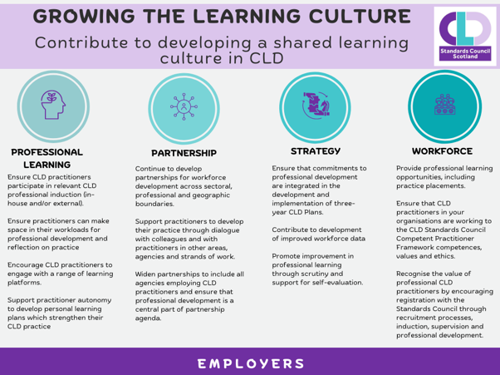
The information from the image is in the following text.
Learning
- Ensure CLD practitioners participate in relevant CLD professional induction (in house and/or external)
- Ensure practitioners can make space in their workloads for professional develop and reflection on practice
- Encourage CLD practitioners to engage with a range of learning platforms
- Support practitioner autonomy to develop personal learning plans which strengthen their CLD practice
Partnership
- Continue to develop partnerships for workforce development across sectoral professional and geographic boundaries
- Support practitioners to develop their proactive through dialogue with their colleagues and with practitioners in other areas, agencies and strands of work
- Widen partnerships to include all agencies employing CLD practitioners and ensure that professional development is a central part of partnership agenda.
Strategy
- Ensure that commitments to professional developments are integrated in the development and implementation of organisational strategy (e.g. three-year CLD plans)
- Contribute to the development of improved workforce data
- Promote improvement in professional learning through scrutiny and support for self-evaluation
Workforce
- Provide professional learning opportunities, including practice placements
- Ensure that CLD practitioners in your organisations are working to the CLD Standards Council Competent Practitioner Framework competences, values and ethics
- Recognise the value of professional CLD practitioners by encouraging registration with the Standards Council through recruitment processes, induction, supervision and professional development
Case Study - Renfrewshire Council’s Adult & Family Learning Training Week
This practice example outlines how Renfrewshire’s Adult and Family Learning (AFL) Service designed and delivered a dedicated staff training week to strengthen professional learning and address workforce challenges. Faced with part-time staffing patterns and limited opportunities to bring teams together, the service introduced a structured approach to continuous professional development by pausing delivery and prioritising shared learning time.
The training programme combined practical and developmental learning, including HENRY (parenting and self-care) and FORT systems training, alongside opportunities for collaboration, reflection and team-building. Staff feedback highlighted improved confidence, stronger connections, and increased capacity to apply new approaches in practice. The team is committed to further developing this dedicated time for professional learning.
This initiative demonstrates a clear commitment to embedding a sustainable learning culture across the service and particularly evidences these key responsibilities of an Employers’ role in Growing the Learning Culture:
- Ensure practitioners can make space in their workloads for professional development and reflection on practice
- Support participation in professional development as an integral part of practice
Provide professional learning opportunities - Support practitioners to develop their practice through dialogue with colleagues and practitioners
If you’d like to find out more about this initiative, contact Isobel Sinclair, Adult & Family Learning Service Delivery Lead.